VR Labs in Schools: What Actually Happens in a Session
VR in education is easy to sell and easy to get wrong. Here's what a session actually involves, and the questions to ask before committing a budget.
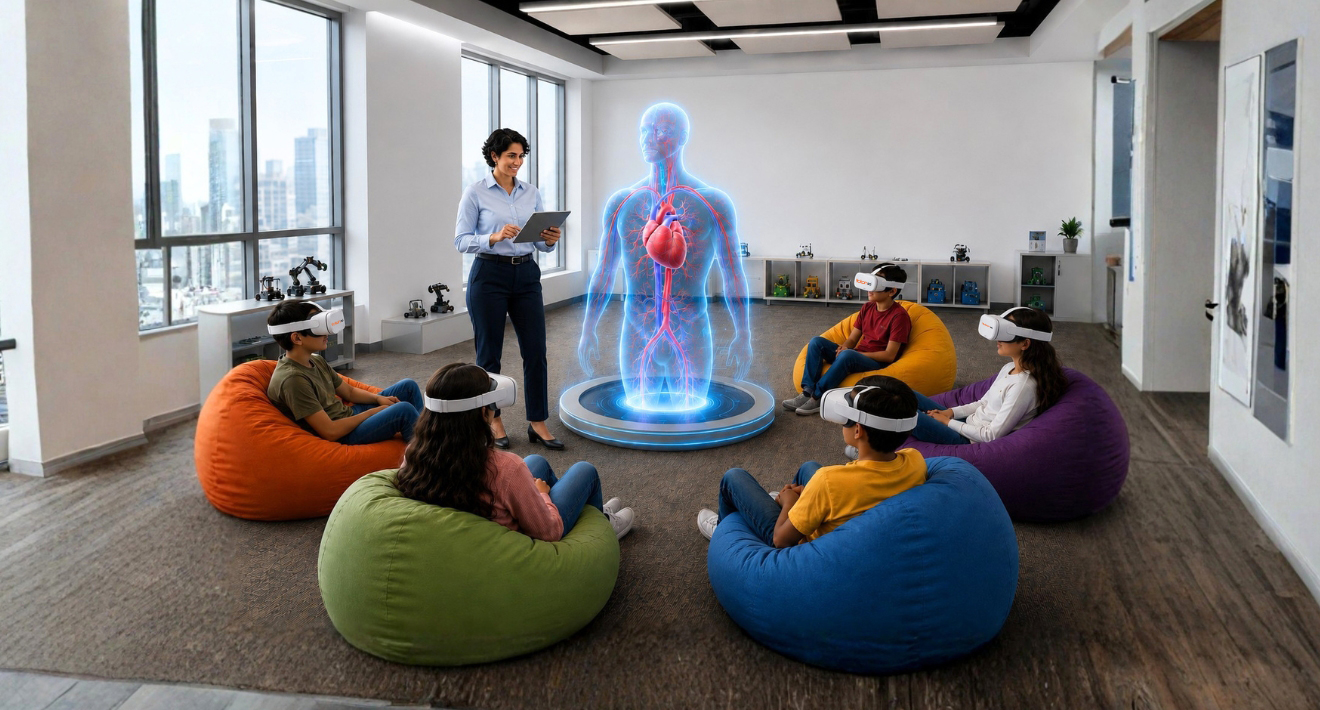
The useful thing about VR in a classroom is specific and narrow: it makes things visible that cannot otherwise be seen. The inside of a working heart. The scale of the solar system. A chemical reaction at molecular level. For those topics it is genuinely better than a diagram. For most other teaching, it isn't — and a school evaluating VR should be clear about which it's buying.
What a session actually looks like
The common assumption is thirty students wandering separately through a virtual world. In practice a school VR session is teacher-led and tightly structured, which is what makes it workable in a 40-minute period.
- The teacher introduces the concept conventionally, as they normally would — five to ten minutes.
- Headsets are handed out and students enter the same module together.
- The teacher drives the session from a tablet or console, moving everyone through the same sequence and pausing to ask questions.
- Headsets come off, and the class discusses what they saw while it's fresh.
Typical headset time is 10 to 15 minutes. That is deliberate — it's enough for the concept to land, and short enough to avoid fatigue and keep the period on schedule.
Which subjects genuinely benefit
- Biology — walking through a cell or a circulatory system, which no textbook diagram conveys at scale.
- Physics — forces, motion and fields rendered in three dimensions instead of on a whiteboard.
- Chemistry — reactions and molecular structures, plus experiments that are unsafe or impractical in a school lab.
- Astronomy — the one topic where the sheer problem of scale makes conventional teaching hardest.
- Geography — landforms and terrain seen from above and within.
- History and social studies — standing inside a monument rather than reading about it.
Notice what isn't on that list: languages, literature and mathematics beyond geometry. VR adds little there, and a vendor claiming otherwise is overselling.
What a school needs to run one
- Headsets in a count matched to your batch size — a class set, or a smaller set rotated between groups.
- A room with space to stand and turn safely. A cleared classroom is usually fine; a dedicated lab is better.
- Curriculum-aligned content, mapped to what teachers are already covering. This is the part that decides whether VR gets used.
- Teacher training, so staff can run sessions without external help.
- Charging, storage and hygiene — a cupboard, a charging routine, and wipeable face pads.
- Local technical support, because a headset that won't pair at 9 a.m. must be fixable that morning.
Questions worth asking any VR vendor
- Is the content mapped to our board and syllabus, or is it a generic library we have to fit around?
- How long does a typical session take, and does it fit a single period?
- Who trains our teachers, how long does it take, and is a refresher included?
- What happens when a headset fails — where does it go and how long are we without it?
- Can we see a live session with real students before committing?
That last one matters most. A demo with two headsets and an enthusiastic salesperson tells you very little. A session with an actual class tells you everything — including how long the handout and setup really take.
Being realistic about the limits
VR supplements teaching; it does not replace a teacher, and any pitch suggesting otherwise should be treated sceptically. A minority of students experience mild discomfort in headsets, so plan a non-VR alternative for them. And as with smart panels, the deciding factor is not the hardware — it's whether teachers are confident enough to use it in week twelve.
fotonVR in Raigarh
We are an authorised fotonVR channel partner, supplying, installing and supporting VR labs for schools across Raigarh and the surrounding districts — headsets, K–12 curriculum-aligned content, teacher training, setup and ongoing service from our own counter.
Free on-site demonstrations for schools in and around Raigarh. See the fotonVR page for the subjects covered and what a full lab includes.
Book a demo at your school and see a real session with your own students before deciding.
Book a fotonVR demo →Net Computers has been on the same counter in Raigarh since 2000. Walk in beside Hotel Tulsi, Ramnivas Talkies Chowk, or call 942-557-0330.
942-557-0330